

Engineering is the application of math and science principles to design and build equipment, structures, and other items.
There are different disciplines of engineering each with a more specific emphasis on particular areas of applied mathematics, applied science, and types of application.
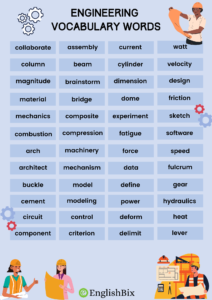
We have prepared a list of some simple daily used vocabulary words for young engineers to get them started with the world of engineering.
Engineering Vocabulary Words A to Z
Following is a glossary of 20+ common engineering terms with their meanings for upcoming Engineers.
| Word | Meaning |
| collaborate | work together on a common enterprise or project |
| column | a tall vertical cylindrical structure standing upright |
| magnitude | the property of relative size or extent |
| material | the substance that goes into the makeup of a physical object |
| mechanics | the branch of physics concerned with the motion of bodies |
| combustion | a reaction of a substance with oxygen to give heat and light |
| arch | a curved masonry construction for spanning an opening |
| architect | someone who creates plans to be used in making something |
| buckle | bend out of shape, as under pressure or from heat |
| cement | a building material that is a powder made of a mixture of calcined limestone and clay; used with water and sand or gravel to make concrete and mortar |
| circuit | an electrical device providing a path for current to flow |
| component | one of the individual parts making up a larger entity |
| assembly | the act of constructing something, as a piece of machinery |
| beam | a long thick piece of material used in construction |
| brainstorm | try to solve a problem by thinking intensely about it |
| bridge | structure allowing passage across a river or other obstacle |
| composite | consisting of separate interconnected parts |
| compression | the process of becoming smaller or pressed together |
| machinery | mechanical or electrical devices collectively |
| mechanism | device consisting of a piece of machinery |
| model | a hypothetical description of a complex entity or process |
| modeling | the act of representing something |
| control | a mechanism that directs the operation of a machine |
| criterion | the ideal in terms of which something can be judged |
| current | a flow of electricity through a conductor |
| cylinder | a chamber within which a piston moves |
| dimension | the magnitude of something in a particular direction |
| dome | a hemispherical roof |
| experiment | the act of conducting a controlled test or investigation |
| fatigue | a weakened state caused by long stress on a material |
| force | influence that results in motion, stress, etc. when applied |
| data | a collection of facts from which conclusions may be drawn |
| define | decide upon or fix with certainty |
| power | (physics) the rate of doing work |
| deform | alter the shape of (something) by stress |
| delimit | determine the essential quality of |
| design | the act of working out the form of something |
| velocity | distance traveled per unit time in one direction |
| watt | a unit of power equal to 1 joule per second |
| friction | the resistance when a body is moved in contact with another |
| sketch | preliminary drawing for later elaboration |
| software | written programs operating on a computer system |
| solar energy | energy from the sun that is converted into thermal or electrical energy |
| speed | a rate at which something happens |
| fulcrum | the pivot about which a lever turns |
| gear | a toothed wheel that engages another toothed mechanism |
| heat | a form of energy transferred by a difference in temperature |
| hydraulics | study of the mechanics of fluids |
| impact | a forceful consequence; a strong effect |
| inclined plane | a simple machine for elevating objects |
| constraint | a limitation or restriction |
| construction | the act of building something |
| lever | a simple machine giving a mechanical advantage on a fulcrum |
| load | weight to be borne or conveyed |
| machine | a device for overcoming resistance by applying force |
| momentum | the product of a body’s mass and its velocity |
| motion | a change of position not entailing a change of location |
| open ended | without fixed limits or restrictions |
| optimize | make optimal; get the most out of; use best |
| patent | a document granting an inventor sole rights to an invention |
| engine | motor that converts energy into work or motion |
| engineering | applying scientific knowledge to practical problems |
| plate | structural member consisting of a horizontal beam that provides bearing and anchorage |
| pollution | contamination of the natural environment |
| propulsion | the act of moving forward |
| pulley | a wheel with a groove in which a rope can run |
| pump | a device that moves fluid or gas by pressure or suction |
| purpose | an anticipated outcome that guides your planned actions |
| raw material | material suitable for manufacture or use or finishing |
Quick Links